


Indiana motorcycle accident payouts range from roughly $15,000 for limited injury cases to $250,000 or more when injuries are severe or permanent. No single statewide figure tells you what your claim is actually worth. Real settlement value turns on the specifics of your injuries, the evidence preserved, and how fault is assigned.
The Indianapolis motorcycle accident lawyers at CohenMalad, LLP evaluate claims to help riders understand their real compensation potential, with no fee unless a recovery is made.
Average Motorcycle Accident Settlement Ranges in Indiana
There is no single average motorcycle accident settlement that reliably predicts what any individual claim will be worth. Settlement figures vary so widely that citing one number without context can mislead riders into accepting less than they deserve or create expectations that don't reflect their situation.
A more useful framework is a range tied to injury severity:
Motorcycle crashes tend to produce more severe injuries than typical car accidents. Riders lack the structural protection of a vehicle frame, which means fractures, road rash, head injuries, and spinal trauma appear far more often in motorcycle claims than in ordinary car crashes.
According to IIHS fatality data, motorcyclists face dramatically higher fatality rates per mile traveled than passenger car occupants. That is a primary reason motorcycle settlements frequently exceed what many car accident cases resolve for.
What Raises a Motorcycle Accident Settlement Amount?
Injury severity is the single biggest factor in determining motorcycle accident injury settlement value. Medical expenses form the foundation of every economic damages calculation, and more serious injuries produce more extensive and expensive treatment histories.
Injuries That Drive Higher Compensation
The injuries most commonly associated with larger settlements include:
- Traumatic brain injuries (TBI): Requiring hospitalization, cognitive rehabilitation, and long-term care.
- Spinal cord injuries: Causing partial or full paralysis with lasting effects on employment and independence.
- Fractures requiring surgical repair: Plates, rods, and extended rehabilitation that drive up both economic and non-economic damages.
- Severe road rash: Requiring skin grafting and often resulting in permanent scarring or disfigurement.
- Internal organ damage: Blunt force trauma that may not be immediately apparent at the scene.
- Permanent disability: Affecting earning capacity and requiring adaptive equipment or home modifications.
According to NHTSA motorcycle safety data, motorcyclists are significantly overrepresented in fatal crash statistics relative to other road users. Crash spikes around Memorial Day and the Fourth of July align with Indiana's prime riding season, and claims filed after those periods often involve the most serious injuries of the year.
Strength of Evidence
Strong documentation gives attorneys far more leverage in settlement negotiations. Riders who preserve crash scene photographs, the damaged helmet and gear, witness contact information, police reports, and complete medical records build a much stronger foundation than those who rely on memory alone. Gaps in documentation are routinely used by insurers to dispute the severity or even the cause of claimed injuries.
Liability Clarity
When fault is undisputed, such as when a driver ran a red light, a police report confirms it, and dashcam footage exists, settlements tend to move faster and resolve at higher values. Disputed liability extends negotiation timelines and gives insurers room to reduce their exposure by shifting partial blame to the rider under Indiana's comparative fault rules.
Number of Liable Parties
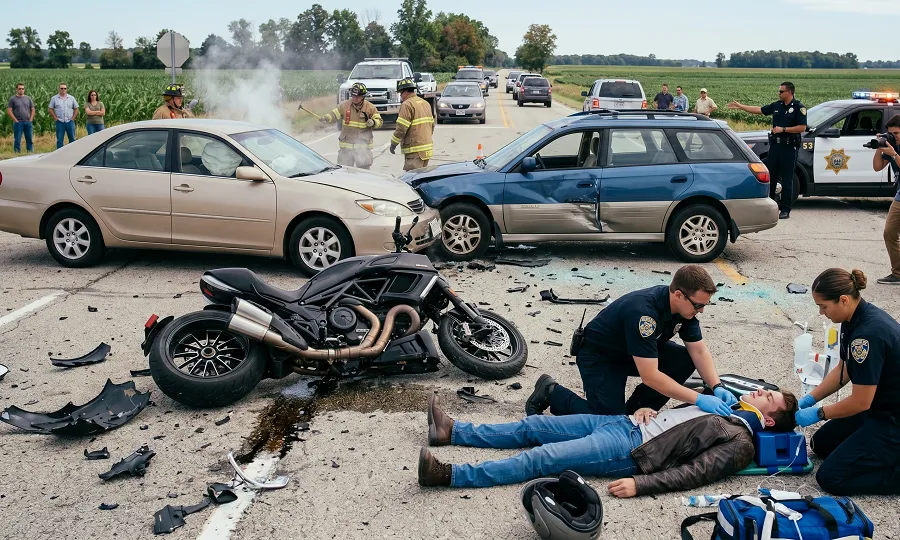
Crashes involving a negligent driver, a road defect, and a vehicle manufacturing defect can produce claims against multiple defendants simultaneously. Identifying every responsible party expands the available pool of recovery and prevents a rider from being limited to what a single insurer is willing to pay.
Insurance Policy Limits
The at-fault driver's coverage ceiling places a hard cap on what can be recovered from that source alone. When minimum-limit policies fall short of actual damages, uninsured and underinsured motorist coverage on the rider's own policy becomes critical. It is a source many riders don't know to pursue until an attorney reviews all available coverage.
Pre-Existing Conditions
Insurers frequently argue that prior injuries were responsible for current symptoms rather than the crash itself. Strong medical documentation that establishes a clear baseline before the accident and connects new injuries directly to the collision is essential to countering these arguments effectively.
Lost Earning Capacity
Riders in skilled trades, professions requiring fine motor control, or cognitively demanding work who suffer hand, arm, shoulder, or brain injuries may face long-term income losses that far exceed their immediate wage loss. Accurately projecting those future losses, which often requires economic and vocational expert testimony, can significantly increase total settlement value.
Economic and Non-Economic Damages in Indiana
Indiana law recognizes two categories of damages in a motorcycle accident lawsuit payout: economic and non-economic. Understanding both helps riders account for the full scope of their losses from day one.
Economic Damages
Economic damages include measurable financial losses directly tied to the crash:
- All emergency room, hospital, and specialist bills
- Physical therapy and rehabilitation expenses
- Prescription medications and adaptive equipment
- Lost income from missed work, with employer documentation
- Future lost earning capacity if injuries affect long-term employment
- Cost to repair or replace the motorcycle
- Home modification costs for serious injuries
Non-Economic Damages
Non-economic damages cover losses that don't come with a receipt but are real and compensable under Indiana law:
- Pain and suffering
- Emotional distress and psychological trauma
- Permanent scarring or disfigurement
- Disability and loss of normal daily activities
- Loss of enjoyment of life
Insurance adjusters and attorneys use treatment records, medical opinions, and documented daily-life impact to assign value to these losses during settlement negotiations. For context on how these categories interact in a real case, the distinction between bodily injury and personal injury coverage is worth understanding before any settlement discussion.
How Indiana Law Shapes Motorcycle Accident Settlements

Several Indiana statutes directly govern how a motorcycle accident lawsuit payout is calculated and when a claim can be filed. Knowing these rules helps riders understand why fault disputes matter so much and why timing is critical.
Modified Comparative Fault: Indiana Code 34-51-2
Indiana comparative fault law reduces a rider's recovery by the rider's percentage of fault. Under Indiana Code 34-51-2, if a rider is found 20% at fault and total damages are $100,000, the recovery is reduced to $80,000. If the rider is found to be more than 50% at fault, Indiana law bars recovery entirely.
This rule makes fault determination central to every average settlement for motorcycle accident negotiations. Insurance adjusters frequently argue that a rider was speeding, lane-splitting, or otherwise contributing to the crash because reducing the rider's assigned fault percentage directly lowers the insurer's exposure.
The Two-Year Filing Deadline: Indiana Code 34-11-2-4
Under Indiana Code 34-11-2-4, most personal injury claims must be filed within two years of the accident date. Missing this deadline generally ends the right to recover compensation. Exceptions can apply in cases involving minors or delayed injury discovery, but riders should not assume an exception applies without legal review.
Insurance Minimums and Underinsured Drivers
Indiana requires all drivers to carry minimum liability coverage, with details available through the Indiana BMV insurance page. When an at-fault driver carries only minimum coverage, that amount may fall far short of actual damages in a serious crash, making uninsured and underinsured motorist coverage a critical piece of any motorcycle accident compensation recovery.
Claims involving government-owned vehicles or road hazards may also trigger separate notice requirements with shorter deadlines. Our Indianapolis motor vehicle accident lawyers can review all available coverage sources and applicable notice deadlines to pursue the full recovery available under Indiana law.
How to Protect Your Indiana Claim Value
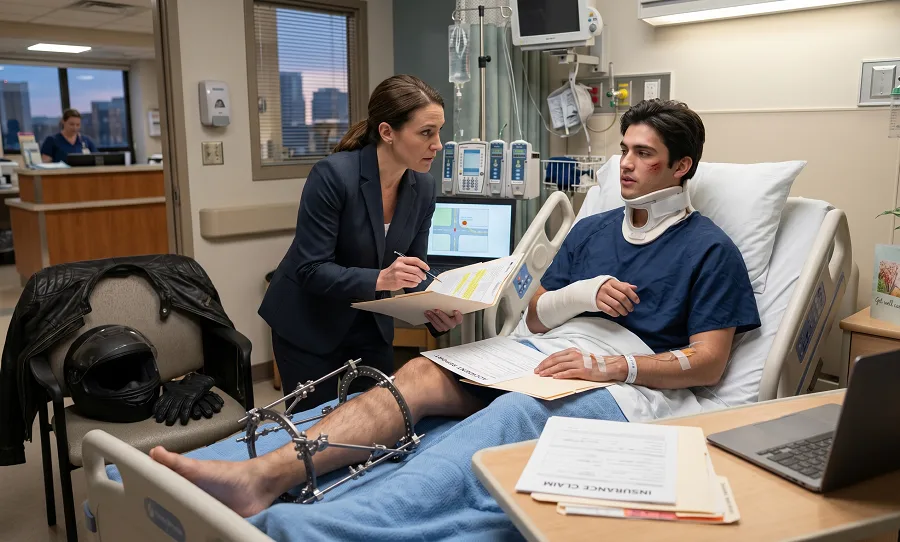
Insurance adjusters often make low settlement offers early, sometimes within days of an accident, before the full extent of injuries is known. Accepting a quick offer can permanently close the right to additional compensation, even if medical complications emerge later.
Steps that protect claim value from the start:
- Seek immediate medical treatment: Even if injuries seem minor, delayed symptoms are common in crash cases, and gaps in treatment can be used against you.
- Follow all treatment recommendations: Attend every follow-up appointment and complete prescribed therapy. Insurers look for missed appointments to argue injuries weren't serious.
- Preserve physical evidence: Keep the motorcycle and helmet intact. Both can demonstrate impact force and be critical in fault disputes.
- Photograph injuries throughout recovery: Document visible injuries at the scene and as they progress, not just at the emergency room.
- Avoid recorded statements: Don't give statements to the at-fault driver's insurer without legal counsel. Those recordings are used to minimize payouts.
- Keep all documentation: Every medical bill, receipt, mileage log, and missed-work record strengthens the damages calculation.
- Hire an experienced attorney: An attorney who handles motorcycle accident injury settlement negotiations regularly understands how insurers assign fault and can counter tactics designed to reduce your recovery.
Find Out What Your Motorcycle Accident Claim Is Really Worth
The average payout for a motorcycle accident in Indiana is only a starting point. Real case value depends on the severity of injuries, the strength of evidence, how fault is assigned, and what insurance coverage is actually available.
Since 1968, our experienced Indiana trial lawyers have helped riders pursue full compensation against insurers determined to pay as little as possible. Contact us today for a free consultation.

Injured in a Motorcycle Crash?
You have enough to deal with in the aftermath of a motorcycle accident. Let us handle the legal steps while you recover. CohenMalad, LLP offers free consultations for Indiana riders, and there’s no fee unless we win.

Jeffrey A. Hammond is a personal injury lawyer who focuses his practice on serious personal injury and wrongful death cases involving construction accidents, premises liability, defective and dangerous products, industrial accidents, state and local governmental liability, structural collapse, scaffolding accidents, crane accidents, and aerial / scissor lift accidents.
.svg)
