

%20(1).avif)
Junk Fee Lawsuit Lawyers
Fighting Back Against Companies That Steal Your Money Through Hidden Fees
Our Class Action Lawsuits Cases
.svg)


1B+
recovered for clients
300+
years of combined experience
500+
cases won
Why Choose CohenMalad, LLP for Your Junk Fee Lawsuit
American consumers pay roughly $90 billion annually in junk fees across all industries, from banking to hospitality to entertainment. These aren't legitimate service charges — they're calculated traps designed to maximize corporate profits at your expense. Our team at CohenMalad, LLP has been taking on these corporate giants for over 55 years, and we know exactly how they operate.
We've built our reputation by going after the biggest names in banking, hospitality, telecommunications, and entertainment and winning. Our firm secured over $100 million for Indiana consumers against predatory fee practices, including major victories against credit unions and state agencies. We don't negotiate quick settlements with companies that offer pennies on the dollar; we fight for every cent they stole from you.
When companies hide mandatory fees until checkout, manipulate transaction orders to generate maximum fees, or collect charges for services that should be included in the advertised price, they're committing theft. We make them pay it back with interest.


.avif)


What Are Junk Fees and Why Are They Illegal
Junk fees represent a massive wealth transfer from working families to corporate shareholders. These hidden, surprise, or deceptive charges get added to advertised prices, often revealed late in the checkout process or buried in fine print that consumers never see until it's too late.
Here's what makes junk fees particularly predatory:
- Drip pricing: Companies advertise low base prices but add mandatory fees later in the booking or checkout process.
- Hidden resort and amenity fees: Hotels add $20 to $50 per night in fees for pools, gyms, or Wi-Fi without disclosing them in initial price quotes.
- Ticketing service fees: Convenience, processing, and facility charges pile onto event tickets at checkout.
- Transaction reordering: Banks process your largest transactions first, triggering the highest overdraft fees on smaller purchases.
- Authorize Positive, Settle Negative (APSN) fees: You're charged overdraft fees even when you had sufficient funds when the transaction was approved.
- Telecommunications administrative fees: Cable company-imposed fees add what amounts to a 24% surcharge on top of advertised prices, generating close to $450 per year per customer.
- Rental application and move-out fees: Landlords charge excessive fees that circumvent rent control limits.
- Early termination penalties: Telecommunication companies charge excessive fees to cancel service.
- Car rental hidden charges: Documentation fees, reconditioning fees, and airport concession fees not disclosed upfront.
The Federal Trade Commission has called these practices unfair and deceptive under federal consumer protection regulations, and multiple federal agencies are now cracking down on junk fees across the economy. However, enforcement remains inconsistent, and private litigation is often the primary means of holding companies accountable.
Major Settlements Prove Widespread Fraud
The evidence of systematic junk fee fraud is overwhelming. Major companies across multiple industries have paid billions in settlements for deceptive fee practices:
Banking: Wells Fargo $3.7 Billion (2022)
The CFPB found Wells Fargo illegally charged customers surprise overdraft fees and other junk fees. The settlement covered millions of accounts dating back over a decade.
Banking: Bank of America $410 Million (Class Action)
One of the largest overdraft fee settlements in history covered transaction reordering practices that generated illegal fees for millions of customers.
Banking: Regions Bank $191 Million (2022)
The CFPB found Regions collected "authorize positive, settle negative" overdraft fees from hundreds of thousands of customers who had sufficient funds when transactions were approved.
Banking: Navy Federal Credit Union $95 Million (2024)
Even military-focused credit unions weren't immune, with Navy Federal paying massive penalties for surprise overdraft fees affecting service members and their families.
Rental Housing: Greystar Real Estate Partners
The FTC and Colorado sued the nation's largest multifamily rental property manager for deceiving customers about monthly rental costs by tacking on numerous mandatory fees for pest control, trash services, and background checks, costing consumers hundreds of millions of dollars since 2019.
Food Delivery: Grubhub $25 Million (2025)
The FTC accused Grubhub of advertising low or no delivery fees while hiding significant service fees and small order fees that increased delivery costs by double or triple the advertised amount.
Car Rentals: Discount, Avis/Budget, Hertz
Multiple car rental companies were penalized for describing fees used to recover operating costs as government-mandated taxes or surcharges.
These settlements represent only cases in which companies were caught and forced to pay. Thousands of businesses continue to engage in similar practices without any accountability.
Industries Where Junk Fees Plague Consumers

Consumer Reports found that Americans had experienced hidden fees across multiple industries: 49% for telecommunications services, 45% for live entertainment or sporting events, 37% for gas and electric utilities, 37% for hotel stays, 35% for air travel, 27% for credit cards, 26% for auto loans and purchases, and 23% for personal banking services.
Banking and Financial Services
Banks manipulate transaction processing to maximize fee revenue:
- Transaction reordering: Banks process your largest transactions first, which can trigger the highest overdraft fees on smaller purchases.
- APSN fees: Banks charge overdraft fees even when you have sufficient funds at the time of the transaction authorization.
- Extended overdraft penalties: Daily fees that accumulate while your account remains negative.
- Multiple NSF charges: Banks collect fees for both declining your payment AND processing it.
- ATM network manipulation: Banks steer you toward high-fee ATMs while concealing fee-free options.
The average American pays $4.73 per out-of-network ATM transaction, with some machines charging over $7. For customers who access cash twice weekly, these fees can exceed $500 annually.
Hotels and Short-Term Rentals
Hotels often hide resort fees until the final booking stage, with fees adding an extra $20 to $50 per night. The hotel industry raked in a record $2.9 billion in resort fees and other surcharges in 2018.
- Resort fees: Mandatory charges for pools, gyms, or Wi-Fi buried in fine print;
- Destination fees: Hidden charges labeled as "local tourism support";
- Early check-in/late checkout fees: Charges for flexible timing not disclosed upfront;
- Cleaning fees: Short-term rentals add massive cleaning charges at checkout.
Live Entertainment and Event Ticketing
Ticketing companies add layers of fees that can double the advertised price:
- Service fees: Undefined charges for basic ticket processing;
- Convenience fees: Penalties for buying tickets online (the primary sales channel);
- Processing fees: Additional charges layered on top of service fees;
- Facility charges: Fees supposedly for venue costs, with no breakdown.
These fees are particularly egregious because consumers have already committed emotionally to attending the event before seeing the true total cost.
Telecommunications

The cable television industry is perhaps the worst offender, with company-imposed fees amounting to a 24% surcharge on top of advertised prices, generating nearly $450 per customer per year.
- Broadcast TV fees: Non-optional fees that cable companies claim help recoup costs for basic programming;
- Regional sports fees: Charges for sports channels, regardless of whether you watch them;
- Administrative fees: Undefined charges for basic business operations;
- Regulatory recovery charges: Companies passing along compliance costs as "fees";
- Early termination fees: Excessive penalties to cancel service contracts.
Rental Housing
Junk fees in rental housing include application fees, pet fees, and move-in or move-out fees, and can result in rental debt that can negatively affect a tenant's credit report. In some cases, these fees are a landlord's way of circumventing legal rent-increase limits.
- Application fees: Charges exceeding actual background check costs;
- Administrative fees: Monthly charges for basic property management;
- Move-in/move-out fees: Excessive charges beyond actual cleaning costs;
- Pet rent and deposits: Monthly fees plus deposits that far exceed any damage costs;
- Trash and pest control fees: Mandatory charges for basic services.
Automotive Sales and Rentals
Car dealers and rental companies add numerous fees that inflate final costs:
- Documentation fees: Charges for basic paperwork that should be included in the price;
- Dealer preparation fees: Costs for preparing new vehicles that dealers are already compensated for;
- Reconditioning fees: Rental car charges for normal wear and tear;
- Airport concession fees: Rental surcharges at airport locations not disclosed in advertised rates;
- Add-on products: Service contracts and GAP insurance with non-transparent pricing.
Utilities and Essential Services
37% of Americans experienced hidden fees for gas and electric utilities, with charges for basic services that should be included in advertised rates.
- Activation fees: Charges to turn on basic utility services;
- Administrative fees: Monthly charges for basic account management;
- Paper bill fees: Penalties for not using electronic billing;
- Payment processing fees: Charges for paying bills online or by phone.
Compensation Available for Junk Fee Victims

Successful junk fee lawsuits typically recover multiple types of damages:
- Full refund of illegal fees with interest calculated from the date of each improper charge;
- Punitive damages for willful violations of consumer protection laws;
- Additional penalties under state consumer protection acts, often 2 to 3 times actual damages;
- Attorney fees and costs in states with fee-shifting consumer protection statutes;
- Injunctive relief requiring companies to change their fee practices going forward.
Understanding Your Potential Recovery
Settlement amounts vary based on several factors:
- Total fees paid over the statute of limitations period (typically 2 to 6 years, depending on your state);
- Severity of company misconduct, as systematic fee schemes typically yield more serious damages than isolated errors;
- Number of affected customers — widespread practices often result in class action settlements with standardized compensation formulas;
- Available evidence of deceptive practices in company internal communications or training materials.
Recent settlements have averaged $150 to $800 per affected customer, with some individual cases recovering thousands of dollars in fees and additional damages.
How CohenMalad Can Win Your Junk Fee Case
We aren't a settlement mill that processes hundreds of cookie-cutter cases. With attorneys recognized among the top in the nation and over $1 billion recovered for clients, we're a law firm that takes cases to trial and wins against corporate giants.
Our Proven Approach to Junk Fee Cases
- Comprehensive transaction analysis using forensic accounting techniques to identify every improper fee;
- Discovery of internal company documents revealing deliberate fee maximization strategies and pricing policies;
- Collaboration with industry analysts who understand pricing systems and regulatory violations;
- Aggressive pursuit of maximum damages, including punitive awards and attorney fees where available;
- Trial-ready preparation so companies know we'll fight their armies of corporate lawyers in court.
We know how these companies operate because we've been beating them for decades. Our $100 million recovery against the Indiana Bureau of Motor Vehicles demonstrates how we handle massive fraud cases involving unfair and unethical fees, and our credit union settlements demonstrate our success against financial institutions specifically.
Why Companies Settle with CohenMalad
Companies track which law firms actually try cases versus those that always settle for nuisance amounts. They know we go to court and win. That reputation gets our clients better settlements because companies would rather pay fair compensation than face us in court.
Our track record includes:
- Major victories against AT&T ($106 million class action settlement);
- Insurance company defeats totaling hundreds of millions in client recoveries;
- Corporate fraud cases where we exposed systematic deceptive practices;
- Consumer protection wins that changed industry practices beyond just monetary settlements.
When you hire CohenMalad, LLP, companies know you're serious about getting justice, not just a quick payout.
The Legal Process for Your Junk Fee Lawsuit
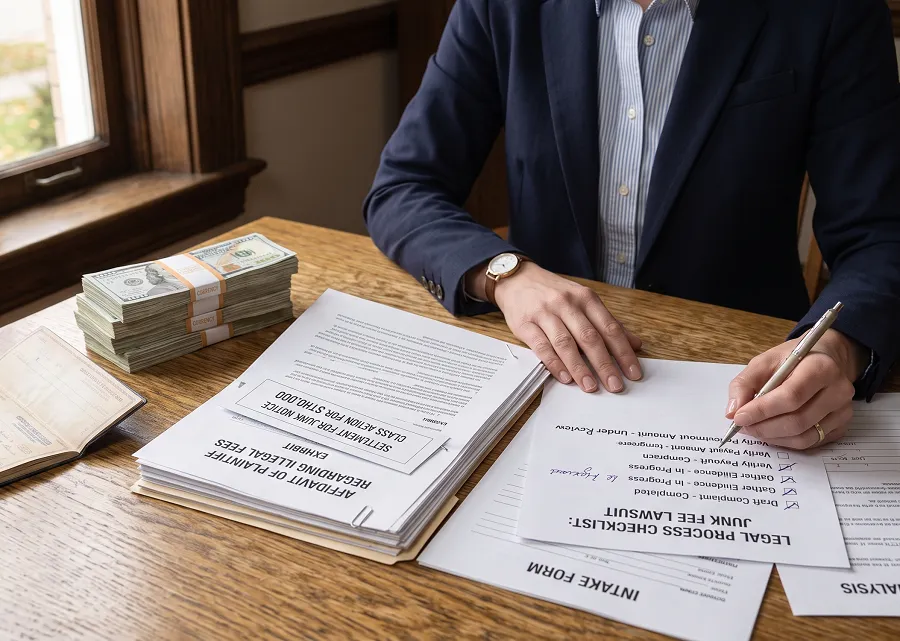
Step 1: Free Case Evaluation
We analyze your transaction history, fee patterns, and potential claims to determine whether you have a strong case. This consultation costs nothing and creates no obligation.
Step 2: Comprehensive Investigation
If you have a viable claim, we obtain complete transaction records, analyze fee processing patterns, and identify specific regulatory violations or contract breaches.
Step 3: Expert Analysis
We work with industry experts to document improper practices and calculate the full scope of damages, including fees that customers typically don't realize were illegal.
Step 4: Strategic Filing
We file a comprehensive lawsuit targeting the specific violations that affected you, whether individually or as part of a class action, depending on the scope of company misconduct.
Step 5: Aggressive Advocacy
We negotiate from a position of strength, backed by thorough preparation and a willingness to try your case. Companies know we're serious, which leads to better settlement offers.
Step 6: Recovery
You receive compensation only after we successfully resolve your case through settlement or trial victory. Our contingency fee structure ensures our interests align with maximizing your recovery.
Time Limits for Filing Your Junk Fee Lawsuit
There's a limited window to file junk fee lawsuits. Each state has its own statute of limitations, giving you a specific number of years from when you discovered (or should have discovered) the illegal fee practices.
Why Timing Matters Urgently
- Missing deadlines eliminates your right to recover stolen fees forever.
- Company records have retention limits, and older transactions become harder to prove.
- Class action deadlines may prevent you from joining larger settlements if you wait too long.
- Interest calculations on fee refunds typically start from the date of improper charges, making earlier filing more valuable.
The discovery rule may extend your filing deadline. Since most customers didn't know companies were manipulating prices or violating regulations, the statute of limitations clock may not have started until media coverage or regulatory actions revealed the problems.
Different types of fee violations have different deadlines, and determining which statutes of limitations apply requires careful legal analysis of your specific situation.
Don't gamble with your right to recovery. Contact us immediately for a free evaluation of your case and filing deadlines.

Find Out How Much These Companies Owe You — Call Now
Companies count on you never learning how their fee schemes work. We'll calculate exactly how much they stole and make them pay it back.
We Won't Let Them Win
Meet Our Consumer Protection Litigation Team
CohenMalad, LLP has spent over 55 years building a reputation for taking on corporate giants in David vs. Goliath battles. Our attorneys have faced down some of the most aggressive corporate defense teams in America and consistently emerged victorious.
Our consumer protection and financial services litigation experience includes cases involving major banks, credit unions, telecommunications companies, hospitality chains, state regulatory agencies, and national corporations. We understand both the technical aspects of pricing systems and the legal theories required to hold companies accountable for junk-fee fraud.
When companies see CohenMalad, LLP on the opposing counsel line, they know they're facing trial lawyers who won't back down. That reputation is your advantage in settlement negotiations.




.avif)
.avif)
%20B.%20Mulligan%20V.avif)



.avif)






Frequently Asked Questions About Junk Fee Lawsuits
Don't Let Cheating Companies Keep Your Money
Junk fees represent billions in wealth stolen from working families by corporations that know most customers will never fight back. The longer you wait, the more evidence disappears and the harder it becomes to prove systematic violations.
Companies count on customer inaction. They design their fee schemes to be confusing, bury disclosures in incomprehensible agreements, and structure charges in ways that maximize their profits at your expense. They're counting on you to give up.
The FTC estimates that requiring upfront disclosure of total prices will save consumers up to 53 million hours of wasted time per year and more than $11 billion over the next decade. But these savings only come when companies are held accountable through enforcement and private litigation.
CohenMalad, LLP won't let them get away with it. We've spent 55+ years taking on corporate giants and winning. We secured $66.5 million and $55 million verdicts because we prepare every case as if it's going to trial, and companies know it.
